
The Time Has Come to Build Bridges
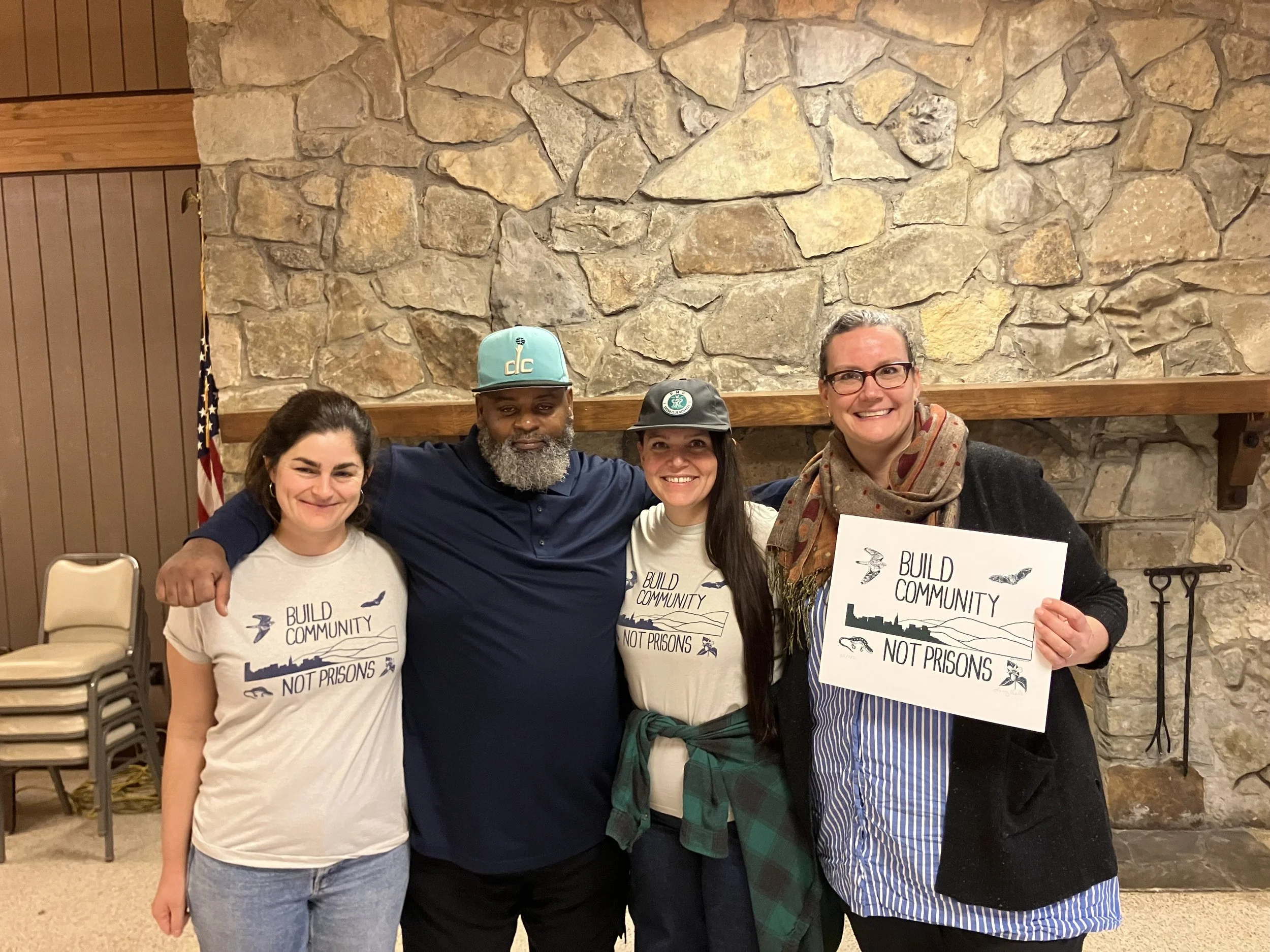
Pictured left to right: Sylvia Ryerson, Umar Muhammed, Sarah Reeves, Julia Finch
Umar Muhammad’s Comments at the Sierra Club Kentucky Chapter Annual Gathering
On Sunday November 9, the final day of the 2025 Annual Gathering at Natural Bridge State Resort Park in the Red River Gorge, Kentucky Sierrans gathered for a presentation titled “Joining Forces: Environmental Justice and the Fight Against Toxic Prisons.” BCNP coalition members Sylvia Ryerson and Umar Muhammad presented Sylvia’s film Calls From Home, followed by a presentation and discussion on the environmental impact of federal prisons in Appalachia. Sylvia and Umar helped our Sierra Club members to see the connection between environmental advocacy and abolition, and that’s taking an incredible step forward towards our collective freedom. Umar’s remarks were an especially poignant reminder of the devastation of toxic prisons on the land and the people, and our need to work in coalition for environmental justice. His powerful words and invitation to join us in this work are shared below.
– Julia Finch, Sierra Club Kentucky Chapter Director
“Because nature is connection. Nature is relationship. And incarceration is disconnection by design.”
Good morning everyone,
First, I want to thank you all — the Sierra Club community — for the decades of work you’ve done to protect the land, the water, the air, and the living things that depend on them. You’ve built a legacy of conservation, and I’m honored to stand here today and build a bridge — between your work and mine — between the struggle for environmental justice and the struggle for human justice.
My name is Cinquan Umar Muhammad, and I spent 30 years of my life incarcerated — most of that time in the Appalachian region, in prisons like Red Onion, Big Sandy, Lee, and McCreary. So when I talk about Eastern Kentucky, I’m not speaking as an outsider. I lived there — not in the way most people mean it, but I lived there. I breathed that air. I drank that water. I looked out at those same mountains you’ve hiked, except I was looking through bars.
And in a very real way, those mountains looked back at me.
You see, there’s a picture that Sylvia took — it’s me standing on top of a mountain, overlooking that same landscape. That mountain had once held me captive, but now I was standing on top of it, free. Every time I look at that picture, it reminds me that healing — for the land and for the people — is the same fight. You can’t separate the two.
When I was inside, I became aware of environmental issues not through textbooks, but through my own skin.
The water in those prisons — the same water that flows through the communities in that region — came out brown some days. It had a chemical taste, an oily film. Over the years, it caused skin rashes, breakouts, irritation. It didn’t matter your race, your background, your crime — the water didn’t discriminate. Everyone’s skin told the same story.
And bottled water? Only if you could afford it. If you didn’t have someone sending you money, you drank what came out the tap — because that was all you had.
The sewage systems broke down often. When it rained heavy or snowed, that water ran off from mountaintop removal sites into the creeks and wells — and into the same systems feeding us. You’d see the same pollution that the local communities were fighting against, but we were powerless to fight it. We were just as impacted, but invisible in the conversation.
That’s why I say: incarcerated people are unrecognized environmentalists. We are forced to live in the conditions that others are trying to prevent.
I know the Sierra Club has a proud history — right here at Red River Gorge — of stopping destructive projects. You all helped protect this very place from being flooded and dammed by the Army Corps decades ago. That legacy is powerful. Because it shows what can happen when environmentalists, lawyers, landowners, and ordinary people come together to stop harm before it spreads.
But I believe we’re now being called to take that same spirit of coalition — and extend it into the realm of justice.
Because what’s happening with the federal prison system in this region — in places like Letcher County — is another form of environmental destruction. Building prisons in toxic, flood-prone, or resource-extracted areas doesn’t just destroy ecosystems; it destroys human ecosystems too — families, communities, and the land itself.
Each new prison built on these lands becomes both a monument to environmental neglect and a symbol of social isolation. And most of the men held there — like me — come from hundreds of miles away, from cities like Washington, D.C. So when those prisons rise, they don’t just affect one county or one watershed — they stretch harm across entire states.
That’s what we mean when we say: the environment and justice are inseparable.
For thirty years, I was separated from nature. I couldn’t touch a tree. I couldn’t feel the rain unless it was through a razor-wire fence. I could see birds fly, but not one could land near me. For people who love the environment — like many of you — imagine what it means to be completely cut off from every living thing that connects us to life itself.
That separation — from nature, from our families, from society — is part of what makes prisons the opposite of what nature teaches us. Because nature is connection. Nature is relationship. And incarceration is disconnection by design.
But that’s why I’m here today — to help reconnect the dots.
To remind us that when we fight to protect a forest, we’re also protecting the air someone breathes in a cell.
When we fight to preserve a river, we’re fighting for the right of every person — free or incarcerated — to drink clean water.
When we say save the land, we’re also saying save the people on it.
Kentucky is my second home. I say that with full heart. Because as much as it held me, it also transformed me. It made me aware of how deeply our fates are tied together — human beings and the environment. The same coal dust that blackens a miner’s lungs finds its way into the lungs of a prisoner. The same contaminated water that poisons a community poisons a cell block.
So, my message today is simple:
Let’s not fight separate battles anymore. Let’s stop drawing lines between environmental justice and human justice. They are one and the same fight — for dignity, for health, for the right to breathe and to belong.
And when you see that picture of me standing on that mountain — remember what it means: That the mountain that once caged me now stands beneath my feet. That healing is possible. That justice — like the environment — is something we all must nurture together.
Thank you.
– Cinquan Umar Muhammad
